US Pushes for Ukraine Peace Deal Amidst International Tensions and Azerbaijani Aid
- Aug 12, 2025
- 4 min read
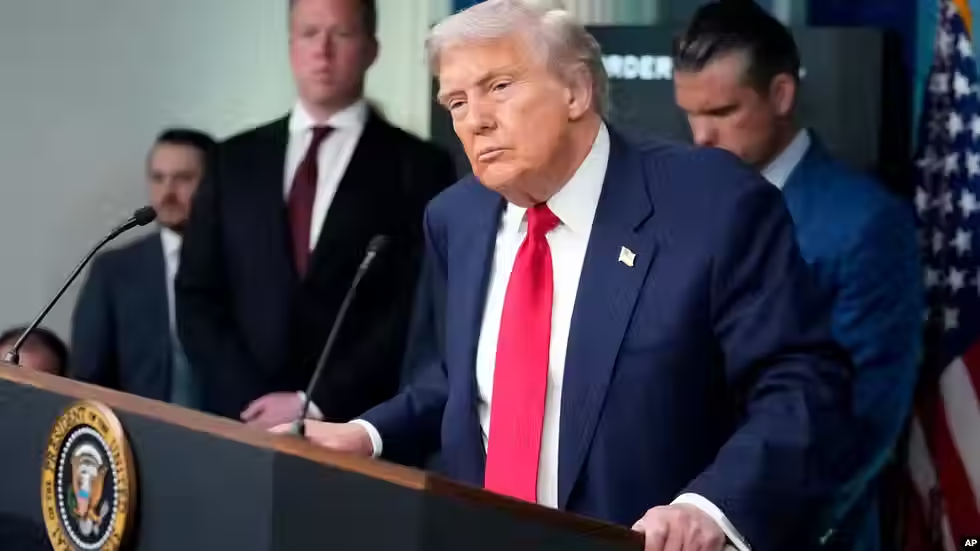
As a critical summit between US President Donald Trump and Russian President Vladimir Putin approaches, the international community watches closely for potential shifts in the ongoing conflict in Ukraine. US Vice President James D. Vance has warned that any eventual peace agreement is likely to leave both Ukraine and Russia dissatisfied.
Diplomatic Push for Peace
President Trump has stated that the primary objective of his meeting with President Putin, scheduled for August 15 in Alaska, is to end the conflict in Ukraine. Trump described the upcoming meeting as a "trial" and expressed hope for constructive talks, after which he intends to engage with European leaders. He further articulated a desire to eventually bring both Putin and Ukrainian President Volodymyr Zelensky to the negotiating table, possibly participating himself to resolve the conflict.
A key element of Trump's proposed solution involves a "territorial exchange" between Russia and Ukraine, an idea he believes would benefit both sides. He stated, "We will take some back and exchange some". This approach, however, has drawn strong reactions, particularly from Ukrainian President Zelensky and European allies, who staunchly support Ukraine's security and territorial integrity. NATO Secretary General Mark Rutte confirmed that any extensive negotiations would "be about territories," alongside security guarantees and Ukraine's right to self-determination.
Recent diplomatic efforts include a "very useful and constructive" meeting between Putin and Steve Witkoff, Trump's special envoy, in Moscow, where "significant progress" was reported. Signals regarding the Ukraine crisis and strategic cooperation were exchanged during these talks. US Secretary of State Marko Rubio also indicated that territorial issues would be a central component for ending the war, with a ceasefire likely to be declared at a certain stage. The US is reportedly seeking agreement from both Kyiv and its European allies for a potential deal.
Russian Demands and European Concerns
Despite diplomatic overtures, the Institute for the Study of War (ISW) suggests that the Kremlin's primary aim for the US-Russia summit is to sow discord between the United States and Europe, rather than genuinely pursuing peace in Ukraine. ISW analysts conclude that Russia is unwilling to compromise on its core objectives, which include preventing Ukraine's NATO membership, replacing the Ukrainian government with a pro-Russian one, and demilitarising Ukraine, effectively leading to its full surrender. Russian political analyst Sergey Markov echoed this, stating that Putin's goal is to present Ukraine and Europe, not Russia, as obstacles to peace, and Russia will make no concessions. Russia is currently demanding the withdrawal of Ukrainian forces from the Donetsk and Luhansk regions in exchange for a halt to Russian offensive operations in Zaporizhzhia and Kherson.
Russia currently occupies over 20% of Ukraine's territory, including the Crimean peninsula (seized in 2014) and significant portions of Luhansk, Donetsk, Zaporizhzhia, and Kherson regions. A high-ranking EU official noted that Russia's position on territorial exchange appears "rather unilateral" given that no Ukrainian territory is under Russian control, while Russia occupies a fifth of Ukraine's land.
Meanwhile, European leaders, while welcoming Trump's peace efforts, underscore the importance of maintaining pressure on Moscow and providing robust security guarantees to Kyiv. A joint statement by leaders from Britain, France, Italy, Germany, Poland, Finland, and the European Commission emphasised that a successful approach must combine "active diplomacy, support for Ukraine, and pressure on Russia to end the illegal war". They have also put forth a counter-proposal to the US plan, suggesting a ceasefire should precede any territorial exchanges, which must be mutual and include security guarantees.
Ukrainian President Volodymyr Zelensky has consistently maintained that the war's conclusion must be just, adhering to international law, which clearly states that all temporarily occupied territories belong to Ukraine. Kyiv Mayor Vitali Klitschko highlighted the immense cost of the war, including lives lost and widespread destruction, acknowledging that the Ukrainian population is growing weary.
In a further sign of escalating tensions, Russia officially announced its abandonment of a unilateral moratorium on the deployment of medium and short-range missiles on August 4, citing "destabilising" missile activities by the "collective West" near Russian borders.
Azerbaijan's Evolving Stance
Azerbaijan has recently increased its support for Ukraine. President Ilham Aliyev signed a decree on August 11, 2025, allocating $2 million in humanitarian aid from the President's Reserve Fund to Ukraine's Ministry of Energy. This aid is specifically designated for the purchase and delivery of electrical equipment produced in Azerbaijan for the Ukrainian energy sector.
This decision followed a telephone conversation on August 10 between President Aliyev and Ukrainian President Volodymyr Zelensky. During this call, both leaders "condemned the deliberate airstrikes by Russia" on an Azerbaijani SOCAR oil storage facility in Odesa and a gas compressor station in Ukraine that transports Azerbaijani gas. They affirmed that these attacks would not impede energy cooperation between their countries. The Russian attacks involved "Shahed" drones on August 8, causing a fire and damaging a diesel pipeline at the SOCAR oil base in Odesa, injuring four workers. Another compressor station was attacked on August 6.
Notably, Azerbaijani pro-government media outlet Caliber, citing anonymous sources, reported that Baku is "considering" lifting its arms embargo on Ukraine if Russia continues its "aggressive policy against Azerbaijan's interests". Some Azerbaijani Telegram channels went further, claiming that a decision has already been made and Baku has begun producing 122mm and 155mm artillery shells for Ukraine. This potential shift marks a departure from President Aliyev's previous public stance in April 2024, where he explicitly stated Azerbaijan would not provide weapons to Ukraine, only humanitarian aid. However, in July 2025, Aliyev openly supported Ukraine, advising them to "never come to terms with the occupation".
Relations between Azerbaijan and Russia have been strained since an Azerbaijani Airlines (AZAL) flight crash in December 2024, which Baku attributes to Russia. Other incidents contributing to this tension include the detention of Azerbaijani diaspora members in Yekaterinburg and the arrest of Russian citizens and staff from the Kremlin-controlled "Sputnik Azerbaijan" agency in Baku. Furthermore, Romania is investigating potential Russian involvement in the contamination of Azerbaijani crude oil en route from Turkey, indicating broader concerns about Russian actions against Azerbaijani economic interests.
Analysts offer differing perspectives on Azerbaijan's response. Arastun Orujlu, head of the East-West Research Center, believes Azerbaijan's options are limited to humanitarian support and statements, citing extensive energy cooperation with Russia and limited military resources. Conversely, Nurlan Aliyev, a senior researcher at the College of Europe, suggests Azerbaijan will take "measured steps" to avoid further provoking Russia, while also strengthening ties with the European Union and the United States, given the perceived threat from Russia. Despite these developments, Azerbaijan has not joined the Western sanctions imposed on Russia.


Comments