Aliyev's Shusha Address: Unpacking Azerbaijan's Assertive Stance on Regional Peace, Zangezur, and Russian Tensions
- Jul 22, 2025
- 5 min read

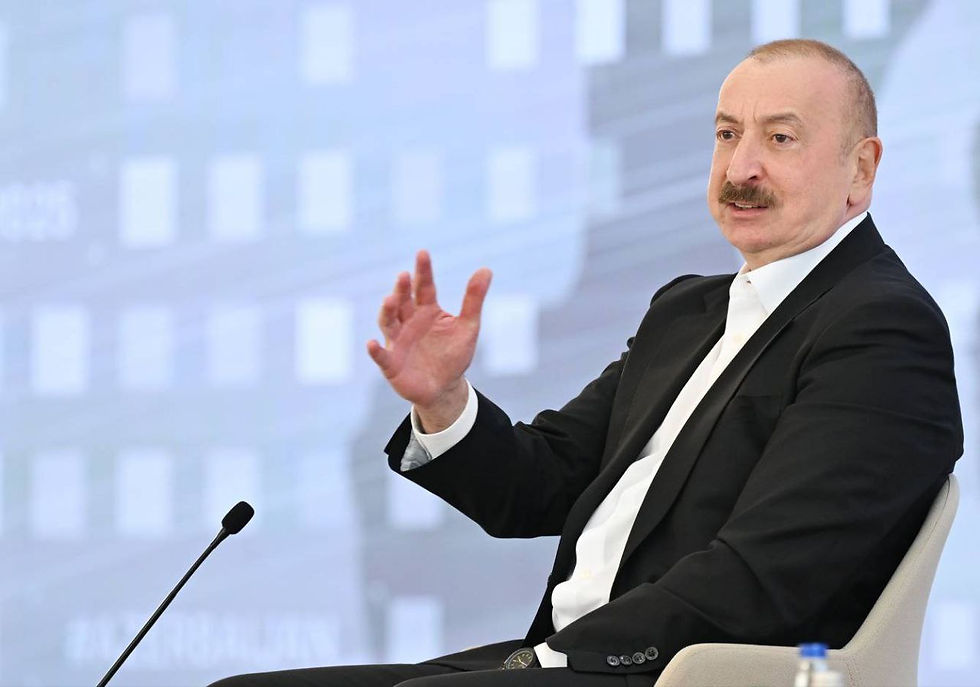
President Ilham Aliyev delivered a comprehensive and assertive address at the 3rd Shusha Global Media Forum in Khankendi on July 19, 2025. His speech delved into critical regional issues, including the ongoing peace process with Armenia, the strategic Zangezur corridor, escalating tensions with Russia following a recent aviation incident, and Azerbaijan's evolving approach to media and information security in the age of artificial intelligence.
For the past three years, Azerbaijan has presented the Shusha Global Media Forum as a pivotal international platform dedicated to information security, media resilience, and communication diplomacy. The 2025 event, attended by 140 representatives from 52 countries, served as a crucial opportunity for President Aliyev to address an international audience and articulate Azerbaijan's position on regional processes with firm rhetoric. For the Azerbaijani government, the forum also functions as a means of seeking international legitimacy, particularly concerning the territories liberated after the Karabakh war, and establishing its stance in the global information flow. This year's theme, "Digital Transitions: Strengthening Information and Media Resilience in the Age of Artificial Intelligence," underscored the contemporary challenges facing media landscapes worldwide.
President Aliyev dedicated a significant portion of his speech to the technical and legal intricacies of peace talks with Armenia. He revealed that while an initial peace agreement text was agreed upon in March 2025, its signing remains contingent on changes to Armenia's Constitution and the formal dissolution of the OSCE Minsk Group.
Aliyev openly expressed his distrust of Armenia's past positions, recalling Nikol Pashinyan's 2019 statement in Shusha: "Karabakh is Armenia, and that's it." He contrasted this with current Armenian statements acknowledging Karabakh as part of Azerbaijan, noting: "At that time, they said, 'Karabakh is Armenia.' This statement marked the beginning of their current difficulties. Now they say that Karabakh should have been recognized as part of Azerbaijan. We offered this back in 2018-2019, but the result is clear." He asserted that Armenia's reliability could only be assessed through "practical changes and the fulfillment of legal obligations," emphasizing that as long as expressions against Azerbaijan's territorial integrity remain in the Armenian Constitution, a peace agreement is impossible. Aliyev also called for the formal abolition of the Minsk Group if the Karabakh issue is truly closed.
Touching upon the US role, Aliyev suggested that contacts with the Trump administration influenced the peace process, stating: "I am fully confident that if Trump had not been elected, Armenia would not have agreed to sign this agreement. They wanted to demand more and gain domestic political dividends." He further highlighted the continued delays in implementing agreed-upon articles concerning border delimitation and the opening of transport links, accusing Armenia of using these issues as "political bargaining."
The Zangezur corridor was presented by President Aliyev not merely as an infrastructure project but as a vital tool for geopolitical integration and strategic pressure. He described it as a "strategic artery connecting the entire Turkic world," emphasizing its role as an "integral part of the Middle Corridor" that will create significant logistical opportunities.
Aliyev's statements made it clear that Armenia's non-participation in this project would lead to its regional isolation. He stressed that Azerbaijan is determined to complete the corridor's technical infrastructure on its territory by 2026, regardless of Armenia's involvement. "If Armenia refuses to join this project, that will be its choice," he declared, adding that Armenia's current inaction "means regional isolation." The corridor is envisioned with an annual transport capacity of 15 million tons and a total length of 43 kilometers, extending from Horadiz towards Meghri, with financing from Azerbaijan's budget.
He underscored Azerbaijan's demand for "unhindered and secure passage" through the corridor, asserting that Azerbaijani citizens "should not have to see the face of an Armenian border guard there every time." Aliyev recalled past incidents during the Soviet era where trains passing through Zangezur on Armenian territory were attacked, stating: "We cannot put our citizens at risk. Therefore, there should be no physical contact there, and guaranteed measures must be implemented for them so that people and cargo move safely."
Regarding the US proposal for a hundred-year lease of the corridor, Aliyev directed the question to the Armenian leadership. Armenian Prime Minister Nikol Pashinyan, while not ruling out the proposal, stated it was merely one of several options under discussion.
For the first time, President Aliyev extensively addressed the incident of the AZAL passenger plane shot down near Aktau, Kazakhstan, on December 25, 2024. While initially presented as a "technical accident," Aliyev's rhetoric shifted, openly suggesting the possibility that the plane was hit by Russian air defense systems.
"Our AZAL plane was hit by a missile near Aktau, Kazakhstan. No one has yet claimed responsibility for this. This is a gross violation of international law," Aliyev stated. He drew a comparison to the MH17 incident and indicated that Azerbaijan is considering appealing to international courts: "Like the MH17 incident, we will take this matter to the legal plane. No one should forget such crimes. This is not just a technical accident."
Without directly naming Russia, Aliyev openly criticized the Russian Federation: "We will not forget this issue. Seven months have passed, but no explanation, no responsibility has been accepted. Such behavior is not consistent with strategic partnership." These statements signal a departure from the pragmatic cooperation model observed in Azerbaijan-Russia relations since 2020, with Azerbaijan now interpreting the incident as a potential act of sabotage or a political message, challenging Russia on political accountability. Aliyev emphasized that "it is impossible to remain silent," and if international law proves ineffective, "new legal mechanisms will need to be created."
Aliyev's speech at the forum also outlined Azerbaijan's information security strategy. He emphasized three key directions:
Media's function to serve state interests: Aliyev defined the role of Azerbaijani media as "protecting the state's information sovereignty," "disseminating the truth," and "responding to international information attacks." He stated: "Azerbaijani media protects the interests of the state. Biased campaigns are being waged against us. Media must be armed with facts to respond to these campaigns."
AI and disinformation: He highlighted the dangers of artificial intelligence, particularly deepfake technology, digital manipulation, and information warfare tools, stressing the need for international cooperation to counter these threats.
Media literacy and legitimization of propaganda: Aliyev repeatedly called for a "fact-based approach," "increasing media literacy," and "teaching information security in the education system," while targeting "biased foreign influences," including some Western media, for spreading false information about Azerbaijan.
This approach signifies a shift in Azerbaijan's information policy, moving "away from the concept of liberal media freedom to a model of information sovereignty and security." This model, where "media security is for the state," aligns with trends observed in countries like Russia, China, India, and some MENA nations.
Finally, President Aliyev addressed the issue of Ukraine, expressing Azerbaijan's "balanced position" rooted in international law, without openly accusing any party. He affirmed support for Ukraine's territorial integrity as a "principled defense of international law," stating: "We recognize the territorial integrity of Ukraine, and this stems from Azerbaijan's respect for international law. The sovereignty of all countries must be inviolable."
Aliyev noted Azerbaijan's continued provision of humanitarian aid to Ukraine, amounting to "several million dollars," framing it as a matter of "solidarity and human responsibility." His statement, "We are neutral, but not indifferent," encapsulates Azerbaijan's attempt to balance diplomatic neutrality with political solidarity. This public articulation of Azerbaijan's stance on a major international conflict, a rare occurrence in his previous speeches, also reflects Azerbaijan's desire to maintain maneuverability in the current geopolitical landscape, considering shifts in the US administration, Russia's influence in the Caucasus, and expanding energy partnerships with the European Union.
President Aliyev's address at the Shusha Global Media Forum provided a clear and assertive articulation of Azerbaijan's foreign policy and strategic priorities. From firm demands in peace talks with Armenia and the determined pursuit of the Zangezur corridor, to strong criticism regarding the AZAL plane incident and a state-centric vision for information security, the speech underscored Azerbaijan's proactive and increasingly independent stance in regional and international affairs.

Comments