Pashinyan's Approval Dips Amidst Public Pessimism and Church Tensions in Armenia
- Jul 24, 2025
- 3 min read
Updated: Aug 2, 2025
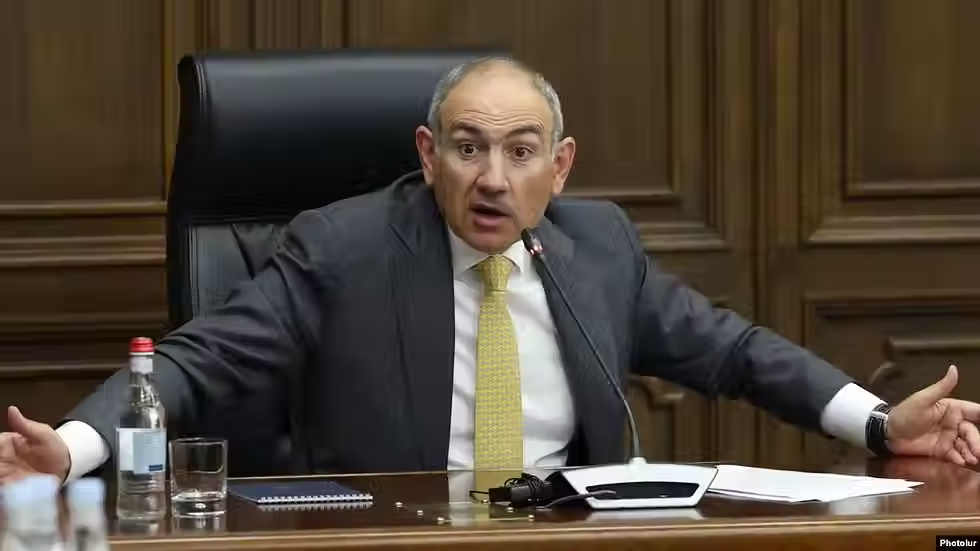
Yerevan, Armenia – A new poll commissioned by the International Republican Institute (IRI) reveals a decline in Armenian Prime Minister Nikol Pashinyan's approval rating and his ruling Civil Contract party's support. The survey, conducted from June 16-26, 2025, also highlights widespread public pessimism about the country's direction, strong trust in the military and church, and divided opinions on a peace treaty with Azerbaijan.
The poll gathered data via telephone interviews with 1,505 Armenian residents, including forcibly displaced individuals from Nagorno-Karabakh who have resided in Armenia for at least six months.
Despite a noticeable decline, Prime Minister Nikol Pashinyan remains Armenia's most trusted political figure. Thirteen percent of respondents expressed confidence in him, a drop from 16% in September 2024. His Civil Contract party has also seen its support fall from 20% in September 2024 to 17% in the latest survey.
Following Pashinyan, Foreign Minister Ararat Mirzoyan garnered 5% trust, while opposition leader and former President Robert Kocharyan's trust rating doubled from 2% to 4% since September 2024. A significant 61% of respondents, however, stated they do not trust any political figure.
The outlook for the 2026 parliamentary elections suggests potential voter apathy, with 28% of respondents indicating they would not participate, 12% planning to spoil their ballots, and 22% remaining undecided.
The Armenian Armed Forces continue to be the most trusted institution in the country, with 72% of respondents expressing full or partial trust. The Armenian Apostolic Church also enjoys high public confidence, with 58% of respondents expressing satisfaction with its work. Notably, trust in the church has risen by 10 percentage points since the last IRI poll, with over 70% of younger respondents (aged 18-35) expressing trust. This comes amidst an escalating crisis between the Armenian government and the Armenian Apostolic Church since late May.
In contrast, trust in state institutions is considerably lower:
Only 38% of respondents trust the Prime Minister’s office, a significant decline from over 80% after the 2018 Velvet Revolution.
The judiciary is trusted by just 31% of respondents, with 52% expressing dissatisfaction.
The National Assembly (parliament) holds the lowest trust among these, at 24%.
Nearly half of Armenians (49%) believe the country is moving in the wrong direction, while only 36% think it is on the right path. This marks a sharp decline in optimism compared to 46% in September 2024 and 50% in December 2023. Pessimism is more prevalent among younger and middle-aged respondents (54% of 18-35-year-olds and 52% of middle-aged individuals believe the country is headed in the wrong direction), while older citizens and pensioners show more optimism.
When asked about the most pressing problems facing Armenia, respondents identified:
Security and border protection (44%)
Economy and unemployment (14%)
Political instability (12%)
Regarding government achievements over the past six months, 42% of respondents believed the Pashinyan government had achieved nothing. Among those who cited achievements, road construction (11%), maintaining peace (9%), and repairs to schools and kindergartens (7%) were the most frequently mentioned.
Opinions on signing a peace treaty with Azerbaijan remain divided. Forty-seven percent of respondents expressed support (29% fully, 18% somewhat), while 40% were opposed (7% somewhat, 33% strongly). An additional 10% stated their support would depend on the final terms of the agreement.
Those who opposed a peace treaty cited security concerns, the risks of war, territorial concessions, distrust, and the perception that terms were dictated solely by Azerbaijan as main drawbacks. Perceived benefits of a peace treaty included the establishment of peace (74%), economic development (9%), and mutual recognition of territorial integrity (8%).
Conversely, Armenia's prospective membership in the European Union enjoys broad support. If a referendum were held, 49% of Armenian citizens would vote in favor of joining the EU, with only 15% against. Thirty-one percent stated they would not vote at all. The main perceived benefits of EU membership include strengthening national security (37%), economic growth (18%), and overall country development (10%). Opponents cited concerns about the corruption of traditional Armenian family values, national identity, new security issues, negative economic impact, and the risk of "angering" Russia.
The survey also shed light on Armenians' views of international partners. Relations with France (89% positive), India (90% positive), and Iran (85% positive) are viewed very favorably. Relations with Russia, however, are seen negatively by 55% of Armenians, with only 43% considering them positive. According to the IRI poll, the three countries with which Armenia has the worst relations are Turkey, Israel, and Azerbaijan.
Steven Nix, IRI's Senior Director for Europe and Eurasia, emphasized the need for the Armenian government to "make serious efforts to engage Armenian youth in political and electoral processes," given that 37% of 18-35-year-olds indicated they would not vote in national parliamentary elections if held next Sunday.


Comments